Choosing the Right Diamond Disc: Grit Size, Thickness & Bonding Explained - Libral Traders
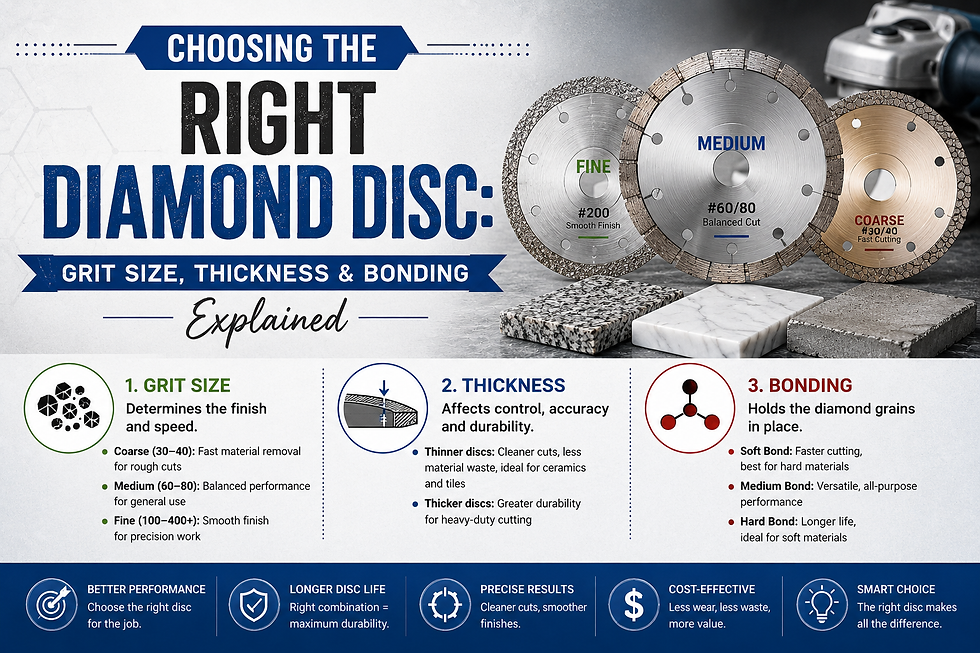
Selecting the right diamond disc is critical for achieving precision, efficiency, and surface quality in dental and laboratory procedures. Whether you’re working on interproximal reduction, contouring restorations, or sectioning prosthetics, understanding how grit size, thickness, and bonding influence performance can dramatically improve outcomes. This guide breaks down the key considerations practitioners should evaluate before choosing a diamond disc.
Understanding Diamond Discs: Why Selection Matters
Diamond discs are thin rotary instruments coated with industrial diamond particles, designed to cut and finish hard materials like enamel, ceramics, and composites. Their effectiveness depends largely on three technical aspects: grit size, disc structure (flexibility and thickness), and coating design. Choosing the wrong combination can lead to rough finishes, excessive heat, or even damage to adjacent teeth.
Coarse vs. Fine Grit: Matching the Task
Coarse Grit (Fast Cutting, Rough Finish)
Coarse diamond discs feature larger abrasive particles (typically 125–180 µm) and are designed for rapid material removal. These are ideal for:
Bulk reduction of restorative materials
Sectioning crowns or bridges
Initial shaping in lab work
However, coarse discs leave a rough surface and should always be followed by finer grits to refine the finish.
Fine & Superfine Grit (Precision & Polishing)
Fine (25–50 µm) and superfine grits are used for smoothing, contouring, and polishing. They are essential for:
Margin refinement
Finishing restorations
Achieving aesthetic surface quality
A multi-step workflow starting coarse and progressing to fine ensures both efficiency and precision. Skipping this progression often results in poor surface quality and additional chairside adjustments.
Flexible vs. Rigid Discs: Control vs. Adaptability
Flexible Discs
Flexible or semi-flexible discs are designed to adapt to curved surfaces. They are particularly useful when working on anatomical contours or finishing restorations.
Examples:
Dentmark Flexible Diamond Disc - Double Sided · ₹800
Flexible double-sided disc designed for contouring and finishing curved dental surfaces.
Edenta Superflex Fine Diamond Disc · ₹1,260
Swiss-made fine grit flexible disc ideal for precision finishing and polishing.
Advantages:
Better adaptation to tooth anatomy
Reduced risk of overcutting
Smoother finishing
Rigid Discs
Rigid discs maintain their shape and provide straight, controlled cuts. They are preferred for:
Sectioning procedures
Straight-line cutting
Laboratory trimming
Key takeaway: Use rigid discs for accuracy in straight cuts, and flexible discs for contouring and finishing curved surfaces.
Single-Sided vs. Double-Sided Discs
Single-Sided Discs (Safety First)
Single-sided discs have diamond coating on only one surface, while the other side is smooth metal. This design protects adjacent teeth and soft tissue during intraoral procedures.
Example:
MR BUR Single-Sided Flexi Diamond Disc · ₹2,740.10
Single-sided disc designed to protect adjacent surfaces during intraoral procedures.
Best for:
Interproximal reduction (IPR)
Work near soft tissues
Precision intraoral adjustments
Double-Sided Discs (Efficiency & Speed)
Double-sided discs are coated on both sides, enabling faster cutting and higher efficiency.
Examples:
Jinguang Double Sided Diamond Disc C04 · ₹80
Economical double-sided disc suitable for general cutting and lab work.
Strauss Diamond Disc 0.10mm Double Side Fine · ₹1,325
Thin fine-grit double-sided disc ideal for interproximal stripping and precision work.
Best for:
Laboratory procedures
Bulk trimming
Situations where adjacent tissue protection is less critical
Thickness & Bonding: Precision vs. Strength
Thickness Considerations
Disc thickness directly affects performance:
Thin discs (0.10–0.20 mm): Ideal for precision cutting and interproximal work
Thicker discs (0.30–0.50 mm): Provide stability and durability for heavy-duty cutting
Thinner discs offer better access and minimal material loss, while thicker discs resist bending and breakage during aggressive procedures.
Bonding Types
Diamond particles are bonded to discs using different methods:
Electroplated: Sharp and aggressive, but may wear faster
Sintered: Longer-lasting and suitable for heavy-duty use
Flexible coated: Designed for contouring and polishing
The bonding method affects durability, cutting efficiency, and lifespan. Sintered discs, for example, maintain cutting ability longer under repeated use.
Application-Specific Selection Guide
Choosing the right disc ultimately depends on the procedure:
Interproximal reduction (IPR): Thin, fine-grit, single-sided discs
Crown sectioning: Coarse, rigid, double-sided discs
Finishing restorations: Fine or superfine flexible discs
Lab trimming: Thick, coarse, double-sided discs
A well-equipped practice typically maintains a range of discs to cover each stage from cutting to polishing.
Conclusion
Choosing the right diamond disc is not just about picking a tool, it’s about matching the instrument to the clinical objective. Grit size determines cutting aggressiveness, flexibility influences control and adaptability, while thickness and bonding impact durability and precision.
By understanding these factors and selecting discs based on specific applications, practitioners can improve efficiency, achieve superior finishes, and enhance overall treatment outcomes. Investing in the right combination of diamond discs ultimately leads to better clinical performance and long-term cost savings.



Comments